Why Controlled Sheer Matters
Carbon nanotubes (CNTs) are among the most powerful functional additives in advanced materials engineering. With exceptional electrical conductivity, mechanical strength, and high aspect ratio, CNTs enable performance breakthroughs in:
Battery electrode slurries
Conductive inks and printed electronics
EMI shielding coatings
Structural conductive composites
However, realizing these properties depends on one critical factor:
Dispersion quality.
Poor dispersion destroys performance. Controlled shear unlocks it.
This is where the EXAKT Three Roll Mill becomes a strategic tool rather than just a mixing device.
Why Carbon Nanotube Dispersion Is So Challenging
CNTs do not arrive ready to perform.
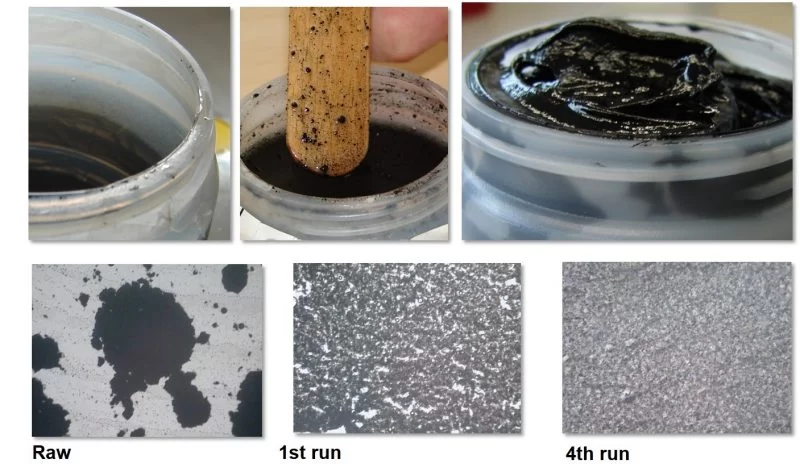
They are typically supplied as tangled, highly agglomerated bundles held together by strong van der Waals forces. These forces cause nanotubes to:
Aggressively re-bundle
Resist wetting in most resin systems
Form conductive “dead zones”
Create rheology instability
If agglomerates are not properly broken down:
Electrical conductivity drops
Percolation thresholds increase
Mechanical reinforcement is reduced
Material costs rise due to overloading CNT content
In high-value systems, especially lithium-ion battery slurries or conductive coatings, improper dispersion directly affects performance, consistency, and margin.
CNT processing is not simply “mixing.”
It is microstructure engineering.
Controlled Shear vs. High-Energy Mixing
Many processors attempt CNT dispersion using bead mills, rotor-stator systems, or high-speed mixers. While these methods can reduce agglomerate size, they introduce risks:
Over-fragmentation of nanotubes
Excess heat generation
Media contamination
Limited repeatability
Broad particle size distribution
CNT performance depends on maintaining aspect ratio. Excessive impact energy can shorten nanotubes and disrupt conductive network formation.
A Three Roll Mill operates on a fundamentally different mechanical principle.
Instead of a chaotic impact, it applies precisely controlled, progressive shear between three horizontally aligned rolls.
How the Shear Mechanism Works
Material passes sequentially through:
Feed roll
Center roll
Apron roll
Each roll rotates at increasing speed, creating a defined shear gradient. Adjustable roll gaps — often in the micron range — allow operators to dial in shear intensity with precision.
This enables:
Deagglomeration of CNT bundles
Uniform distribution throughout the matrix
Preservation of nanotube aspect ratio
Stable rheological behavior
Repeatable batch-to-batch performance
Rather than brute force energy, the process relies on gap-controlled shear refinement.
Where Three Roll Mills Create Competitive Advantage
CNT dispersion is not a laboratory curiosity. It is a scale-up challenge with direct commercial impact.
1. Energy Storage (Battery Electrode Slurries)
Uniform CNT distribution creates more effective conductive pathways in cathode and anode formulations. The result:
Lower internal resistance
Improved rate capability
Reduced inactive material loading
Better cycle performance
Even slight improvements in conductive network formation can yield measurable gains in battery efficiency.
2. Conductive Inks & Printed Electronics
In screen printing, gravure, or inkjet applications, dispersion quality determines:
Line consistency
Predictable sheet resistance
Print resolution
Rheological stability
Agglomerates lead to clogging, inconsistent conductivity, and rejected batches. Controlled shear enables the uniformity required for high-precision printed electronics.
3. EMI Shielding & Advanced Coatings
EMI shielding systems depend on network continuity. A Three Roll Mill helps achieve:
Lower CNT loading to reach the percolation threshold
Cost savings from reduced filler use
Improved film uniformity
Lower filler loadings also maintain mechanical properties and reduce weight.
4. Advanced Structural Composites
In structural conductive composites, proper CNT dispersion:
Enhances mechanical reinforcement
Improves fracture resistance
Reduces defect concentration
Poor dispersion creates stress concentrators. Controlled shear mitigates that risk.
5. R&D to Production Scale-Up
One of the strongest advantages of the Three Roll Mill platform is scalability.
Formulation scientists can:
Precisely adjust roll gaps
Document shear conditions
Reproduce dispersion parameters
Transition from lab to pilot to production
This controlled, measurable process environment supports predictable scale-up — critical in high-value advanced material development.
Why the EXAKT Three Roll Mill Platform Is Engineered for CNT Processing
EXAKT systems are designed for precision dispersion applications, not general-purpose mixing.
Key technical advantages include:
Micron-level roll gap adjustment
Progressive shear refinement
Repeatable operating parameters
Minimal contamination risk
Controlled thermal impact
When processing CNTs, the objective is not maximum energy input. It is an optimized shear application.
For formulators working in conductive systems, that distinction directly impacts performance, yield, and cost efficiency.
Explore the EXAKT Three Roll Mill product line here:
https://exaktusa.com/three-roll-mill-products/
Final Perspective: Dispersion as a Strategic Differentiator
In advanced materials markets, dispersion quality separates commodity processing from engineered performance.
With CNT systems:
Shear control matters more than brute force
Microstructure determines conductivity
Repeatability drives commercial success
A Three Roll Mill does not simply blend materials.
It allows you to engineer dispersion with intent.
If you are developing CNT-based formulations and want to optimize conductivity, rheology, and material efficiency, a controlled shear platform should be part of your evaluation process.